
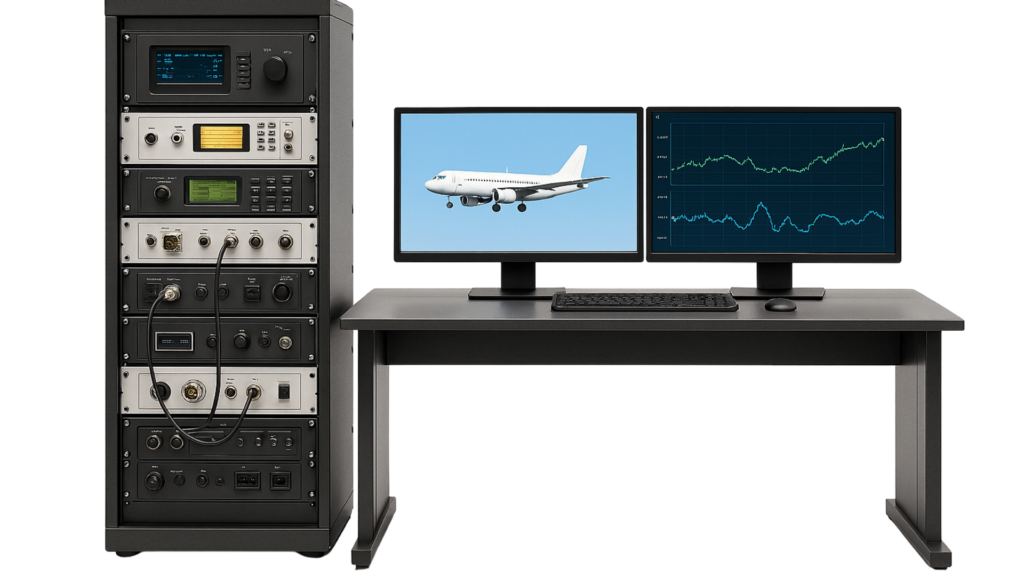
ARINC 429 is the most widely used data bus in commercial aviation: the standard that lets flight management computers, air data systems, radios, displays and hundreds of other avionics units exchange information reliably. If you design, integrate, test or maintain avionics, you will meet it constantly — yet most of the reference material available online consists of decades-old PDFs. This guide explains how ARINC 429 actually works, in plain engineering language, and how it compares to the other great avionics bus, MIL-STD-1553.
What is ARINC 429?
ARINC 429, formally “Mark 33 Digital Information Transfer System (DITS)”, is a specification published by Aeronautical Radio, Inc. (ARINC) that defines how avionics equipment on commercial aircraft transfers digital data. It covers the physical layer (wiring, voltage levels, timing) and the data format (the 32-bit word and its label system). Introduced in the late 1970s, it remains standard equipment on airliners and business jets today, including Airbus and Boeing families.
Its longevity comes from a deliberate design philosophy: simplicity and determinism over flexibility. Each connection does one thing, in one direction, at a fixed rate — which makes the system easy to certify, easy to troubleshoot, and extremely robust.
How ARINC 429 works
Topology: one transmitter, many receivers
ARINC 429 is a simplex (one-way) bus. Each bus has exactly one transmitter, which may broadcast to up to 20 receivers over a single twisted, shielded pair. If a unit needs to both send and receive, it uses separate ports and separate wire pairs for each direction. There is no bus arbitration, no addressing of terminals and no central controller: receivers simply listen and pick out the words whose labels they care about.
Electrical characteristics and speeds
- Medium: a twisted shielded pair carrying a differential, bipolar return-to-zero (RZ) signal. Logic states are encoded as roughly +10 V (“HI”), 0 V (“NULL”) and −10 V (“LO”) measured line-to-line.
- Speeds: two standard rates — high speed at 100 kbit/s and low speed at 12.5 kbit/s. A given bus runs at one rate only.
- Word gap: consecutive words are separated by a gap of at least 4 bit times, which is how receivers detect word boundaries without a separate clock line.
The 32-bit word format
Everything on an ARINC 429 bus travels in fixed-length 32-bit words with five fields:
| Bits | Field | Purpose |
|---|---|---|
| 1–8 | Label | Identifies the data type (e.g. pressure altitude, selected heading). Transmitted first, octal-coded. |
| 9–10 | SDI (Source/Destination Identifier) | When used, distinguishes between multiple data sources or intended destinations. In some applications these bits may instead be used as part of the data field. |
| 11–29 | Data | The payload: BNR (two’s-complement binary), BCD, or discrete bits, per the label’s definition. |
| 30–31 | SSM (Sign/Status Matrix) | Sign or status information: normal operation, no computed data, functional test, failure warning. |
| 32 | Parity | Odd parity bit for error detection. |
Labels: the heart of the protocol
The 8-bit label tells receivers what the word contains. The ARINC 429 specification maintains an extensive label list assigning octal label numbers per equipment type — label 203 for pressure altitude from an air data computer, for example. Each label also defines the encoding (BNR, BCD or discrete), the units, the resolution, the range and the minimum/maximum transmit interval. In practice, integrating an ARINC 429 device means working line by line through its Interface Control Document (ICD), which lists exactly which labels it transmits and expects.
Data encoding: BNR, BCD and discretes
- BNR (binary): binary encoding used for continuous numerical parameters. Scaling, resolution and sign convention are defined by the applicable ARINC data definition and equipment ICD. The most common encoding for continuous parameters such as altitude, airspeed or heading.
- BCD (binary-coded decimal): decimal digits packed into the data field, typically for values shown directly to the crew, such as radio frequencies or DME distance.
- Discrete: individual bits carrying on/off states — valve open, gear down, flag set.
ARINC 429 vs. MIL-STD-1553: what’s the difference?
MIL-STD-1553 is the military counterpart: a dual-redundant, command/response bus in which a Bus Controller orchestrates all traffic among up to 31 Remote Terminals on a shared pair. The two standards embody opposite philosophies:
| Characteristic | ARINC 429 | MIL-STD-1553 |
|---|---|---|
| Primary domain | Mostly commercial aviation, but it is also used on some military aircraft, like the ATR-72 MPA (for example) | Also commercial aviation: some systems in 787, for example |
| Architecture | Simplex: 1 transmitter → up to 20 receivers | Shared bus: Bus Controller + up to 31 Remote Terminals |
| Direction | One-way per bus (separate pairs per direction) | Bidirectional, command/response |
| Control | None — broadcast only | Bus Controller schedules every transfer |
| Data rate | 12.5 or 100 kbit/s | 1 Mbit/s |
| Word size | 32 bits (label + data) | 20-bit words, messages up to 32 data words |
| Encoding | Bipolar RZ | Manchester II bi-phase |
| Redundancy | By duplicating buses as needed | Dual-redundant bus built into the standard |
| Wiring cost | More pairs (one per source) | Fewer buses, more complex terminals |
Neither is “better”: ARINC 429 minimises complexity and certification risk per connection, while MIL-STD-1553 minimises wiring and provides deterministic two-way command and control — which is why retrofit, test and integration programmes so often need both on the same bench, plus a bridge between them. In order to keep the same cabling while increasing bandwidth, “Enhanced MIL-STD-1553” is now on the radar of a lot of companies.
Testing, simulating and monitoring ARINC 429
Almost every avionics development, production or MRO task eventually requires generating and analysing bus traffic:
- Simulation: when the real LRU is unavailable, a simulator transmits its labels with realistic timing so the rest of the system can be integrated and tested. Portable units such as our PT-100 rugged portable flight & lab test unit generate and monitor ARINC 429, MIL-STD-1553, synchro and discrete signals in the lab or on the flight line.
- Monitoring: passive reception and decoding of live traffic for troubleshooting, data recording and acceptance testing — the role of dedicated bus monitors such as the ASIU-L series.
- Protocol conversion: bridging ARINC 429 to MIL-STD-1553, synchro, serial or Ethernet so legacy and modern equipment can coexist — the job of ruggedised converters such as the GPCU general purpose converter unit or the ASIU-E avionics serial interface unit.
- Complete test benches: for production and MRO, turnkey test benches combine simulation, monitoring and scripted test sequences with full repeatability and reporting. This is a core capability for us at Sensicore.
Frequently asked questions
Is ARINC 429 still used in modern aircraft?
Yes. Newer aircraft add higher-bandwidth networks such as ARINC 664/AFDX for data-intensive systems, but ARINC 429 remains in service across current airliner and business-jet fleets for a huge number of point-to-point avionics connections — and will be maintained, tested and integrated for decades to come.
How many devices can share an ARINC 429 bus?
One transmitter and up to 20 receivers. A unit that must talk in both directions uses separate transmit and receive ports on separate wire pairs.
What is the difference between high-speed and low-speed ARINC 429?
Only the bit rate: 100 kbit/s versus 12.5 kbit/s. The word format and electrical interface are otherwise the same, but a single bus operates at a single speed and all its receivers must match it.
Can I connect ARINC 429 equipment to a MIL-STD-1553 system?
Not directly — the electrical layers and protocols are incompatible. A protocol converter that terminates each bus correctly and remaps data between an ARINC 429 label set and 1553 messages is the standard solution in retrofit and integration programmes — exactly the role our GPCU general purpose converter unit was designed for.
Need to simulate, monitor or convert avionics buses?
Sensicore supplies flight-qualified and lab-grade equipment for ARINC 429 and MIL-STD-1553 work: portable test units, bus monitors, protocol and synchro converters, and turnkey test benches — plus application engineering to adapt them to your ICD. Browse our avionics and databus solutions or contact our engineering team to discuss your integration or test programme.